Your Anxiety Has a Pattern. Here’s How to Break It.
Anxiety is one of the most common psychological challenges in the modern world. But it’s also one of the most misunderstood.
It’s often treated as a vague emotional state, a background mood to manage or suppress. But clinically and practically, anxiety is better understood as a patterned process. A feedback loop. A self-reinforcing system made of identifiable triggers, thoughts, physical responses, and avoidance behaviors.
In other words, anxiety isn’t just a feeling. It’s an algorithm.
And if you want to change it, you don’t need to feel stronger. You need to understand how that algorithm runs and how to interrupt it.
That’s exactly what the Anxiety Test is designed to help you do.
A Full Picture of Where You Are
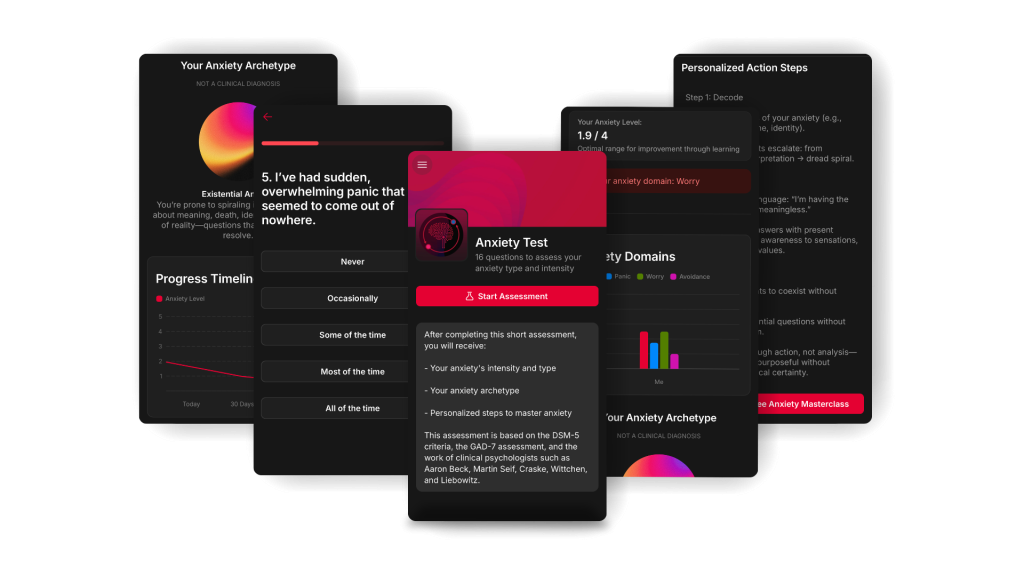
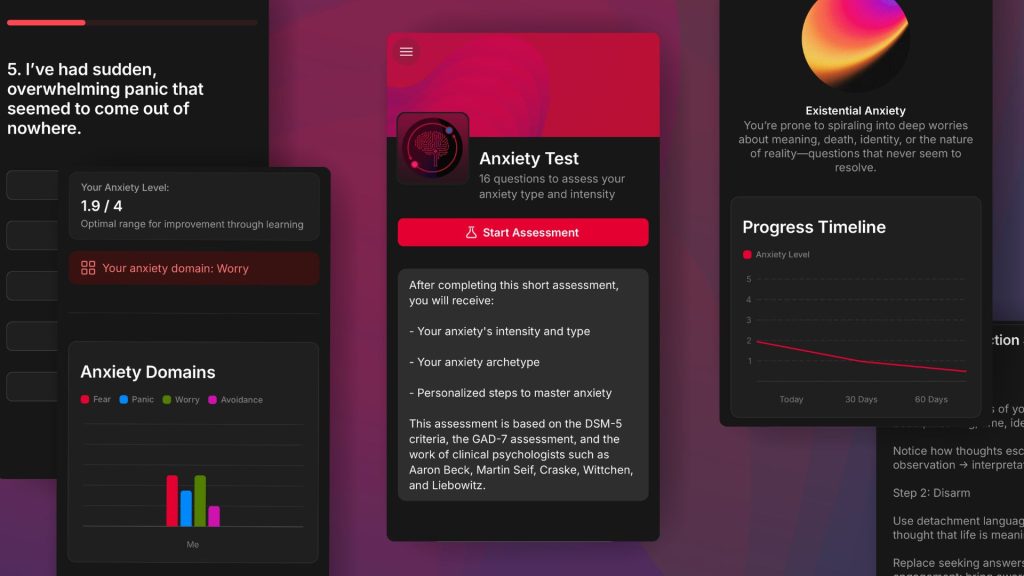
The anxiety test provides:
A score for each anxiety domain, so you can see where your anxiety concentrates
A dominant type that reveals the clearest pattern in your experience
A set of personalized behavioral indicators, grounded in your highest responses
And a trajectory for what progress might look like at 30 and 60 days, based on the system behind it
You’re not given abstract advice. You’re given a precision-matched process.
Systems designer and bestselling author Ryan A Bush synthesizes the best clinical data on anxiety into a comprehensive and actionable process.
Integrating the insights of:
Martin N. Seif, PhD
Founder of the Anxiety and Depression Association of America and author of What Every Therapist Needs to Know About Anxiety Disorders
Judith S. Beck, PhD
CBT pioneer, author of Cognitive Therapy: Basics and Beyond, and President of the Beck Institute for Cognitive Behavior Therapy.
David A. Carbonell, PhD
Clinical Psychologist specializing in anxiety treatment and author of The Worry Trick and the Panic Attacks Workbook
Based on Clinical Principles. Translated for Real Life.
The test and the system behind it are rooted in evidence-based practices, including:
Cognitive Behavioral Therapy (CBT), particularly its focus on appraisal, distortion, and avoidance
Exposure and Response Prevention (ERP), which is foundational for reducing fear and panic-based anxiety
Acceptance and Commitment Therapy (ACT), emphasizing psychological flexibility and response over control
And elements of systems theory and behavioral reinforcement models
But unlike most clinical interventions, this isn’t filtered through a diagnostic manual. It’s translated into real-world behaviors, in real-world language. The goal is not just accuracy—but usability.
Your Personalized Process: Decode. Disarm. Dismantle.
Once your dominant anxiety type is identified, you receive a custom protocol built from The Anxiety Algorithm Program. Each is structured in three stages.
Decode You begin by mapping your anxiety system using a four-node model.
What sets it off
How it feels in your body
What thoughts it activates
And what actions you take to avoid or manage it
This turns vague emotional chaos into a structured, observable loop.
Disarm Here, you learn to change how you relate to the anxiety. Not by calming it down, but by letting it activate without fueling it. You’ll practice:
Cognitive defusion techniques (noticing your thoughts rather than engaging them)
Interoceptive exposure (learning to tolerate anxious sensations)
Voluntary discomfort and mindfulness-based distancing
Dismantle Finally, you begin to reverse the loop entirely. You confront the situations or emotions you’ve avoided. You remove the safety behaviors that have kept the system intact. And you use exposure not to prove you can survive anxiety, but to show your brain it’s no longer needed.
This process isn’t about pushing through anxiety with willpower. It’s about removing the conditions that keep it necessary.